Michael Darlan

Here’s a fun exercise. Count how many people on your team are watching security alerts at 3 a.m. on a Sunday.
If the answer is “well, Dave’s phone is on,” this article is for you.
The short answer: A managed security service provider (MSSP) is an outside team that monitors, detects and responds to threats in your environment around the clock.
It works alongside your IT or security staff instead of replacing them, giving you 24/7 coverage, specialist skills and threat intelligence for less than building a full security operations center (SOC) yourself.
The best partnerships come down to clear roles, a shared incident response plan, and regular reviews.
What does an MSSP actually do?
An MSSP takes on the security work that needs constant attention and specialist skills. The exact menu varies, but most cover some mix of:
- 24/7 monitoring of logs, endpoints, identities and cloud apps, usually through a managed SIEM
- Detection and response, often sold as managed detection and response (MDR), where analysts investigate alerts and contain threats
- Vulnerability scanning and help deciding what to patch first
- Security awareness training and phishing simulations for your staff
- Compliance support, including the evidence auditors and cyber insurers ask for
The key word is managed. You’re not buying another tool and hoping someone looks at it. You’re buying the people who look at it, every hour of every day.
In-house SOC vs. MSSP vs. MDR
The terms get mixed up a lot, including by vendors. Here’s the practical difference.
| In-house SOC | MSSP | MDR | |
|---|---|---|---|
| Who watches alerts | Your own analysts | Provider’s analysts | Provider’s analysts |
| Coverage | Only as many shifts as you staff | 24/7 | 24/7 |
| Main focus | Whatever you build | Broad monitoring and managed tools | Detecting and stopping active threats |
| Responds to threats | Yes, if staffed | Varies, sometimes alerts only | Yes, including containment |
| Time to get running | Months to years | Weeks | Weeks |
| Best for | Large teams with budget and talent | Companies needing broad coverage | Companies needing fast, hands-on response |
In practice, many providers, OneAxiom included, offer both: managed monitoring across your stack, plus analysts who actually step in when something is wrong. Ask any provider which column they really live in.
Benefits of working with an MSSP
A good provider works as a force multiplier for your team, not a replacement for it.
Coverage when nobody’s at their desk. Attackers love nights, weekends and holidays. A provider’s SOC doesn’t take Thanksgiving off.
Skills you can’t hire fast enough. Security talent is expensive and hard to keep. ISC2’s 2025 workforce study found staff and budget cuts are raising perceived security risk, and that teams now struggle more with missing skills than missing headcount.
Fewer alerts reaching your team. A tuned SIEM and experienced analysts filter out the noise. At OneAxiom, 96% of alerts get handled before they ever reach a client’s team.
Threat intelligence you’d never see alone. A provider watching many environments spots a new attack in one place and protects everyone else before it spreads.
Your people get their time back. When someone else handles the 2 a.m. triage, your IT team can work on the projects that actually move the business. Our clients reclaim more than 120 days of IT time a year.
Predictable cost. A monthly service fee is easier to plan than salaries, tools, training and turnover for a 24/7 in-house team.
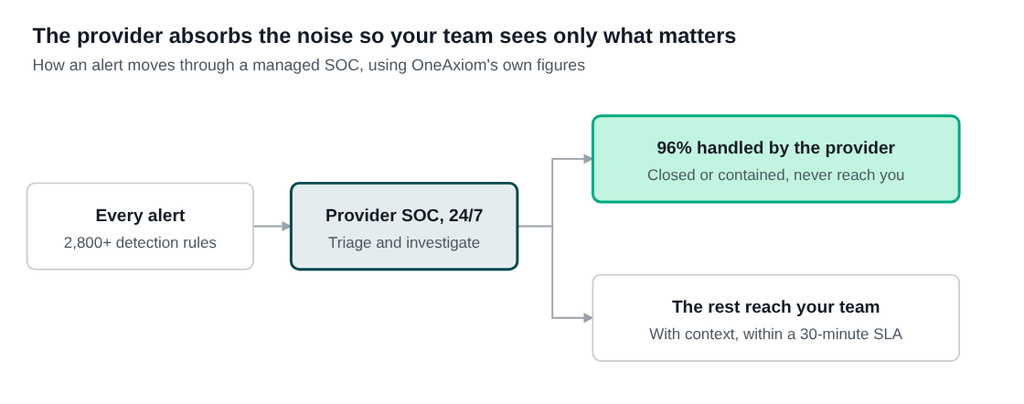
That split is the whole point. Your team stops drowning in alerts and starts seeing only the ones that need a decision from someone who knows the business.
How to choose an MSSP (and make it work)
Most MSSP disappointments aren’t about the tech. They’re about nobody agreeing who does what when the alert fires. Ask these before you sign.
- Who do we talk to, and how fast? Get named contacts, an escalation path and a response SLA in writing. Ours is 30 minutes, and we’d rather beat it than explain it.
- What happens during an incident? Walk through a shared incident response plan. Who contains the laptop? Who calls legal? Who tells the CEO? Every stage needs an owner on each side.
- Will you actually respond, or just alert? Some providers stop at “we noticed something.” Make sure they can isolate machines, disable accounts and remove malicious email.
- How do you fit into what we already have? A good provider works with your existing tools, identity provider and ticketing system instead of making you rip everything out.
- What do you detect, specifically? Ask how many detection rules they run, how they’re tuned, and how often they add new ones. “We use AI” is not an answer.
- How will we review the partnership? Monthly or quarterly reviews keep both sides honest. Look at what was caught, what was missed and what should change.
And don’t outsource the culture. Your provider can catch the click. Your people still decide whether to make it, so keep awareness training going on your side too.
Frequently asked questions
What is a managed security service provider (MSSP)?
An outside company that monitors and manages an organization’s security, usually around the clock. Services often include SIEM monitoring, detection and response, vulnerability scanning, training and compliance support.
What’s the difference between an MSSP and MDR?
An MSSP typically manages a broad set of security tools and monitoring. MDR focuses on detecting and actively responding to threats. Many providers offer both.
Does an MSSP replace my IT or security team?
No. A good MSSP works alongside your team, handling 24/7 monitoring and specialist work so your people can focus on the business.
Is an MSSP cheaper than an in-house SOC?
For most small and midsize companies, yes. Staffing a 24/7 SOC means several analysts, tools, training and turnover, while an MSSP spreads those costs across many clients.
What should I look for when choosing an MSSP?
Clear response SLAs, named contacts, a shared incident response plan, the ability to actively contain threats, integration with your existing tools, and regular partnership reviews.
Let your IT guy turn his phone off
You don’t need to build a security operations center to have one watching your back. The right provider gives you 24/7 eyes, specialist skills and a plan for the bad day, while your team gets back to the work only they can do.
If you’d like to see how your current setup compares, book a call with our team. We’ll walk through your environment and show you where the gaps are, whether or not you work with us.
By Michael Darlan, Cybersecurity Specialist at OneAxiom
Sources
- ISC2: 2025 Cybersecurity Workforce Study (December 2025)